Tank technology challenges: Why hybrid-electric drives help
"The evolution of combat vehicles requires balancing heavy firepower with mobility and protective layers that can withstand modern explosive threats."
Tank technology challenges involve managing the trade-off between increasing armor thickness and maintaining fuel efficiency through advanced propulsion. This guide examines how manufacturers address turret armament, hull modifications, and energy consumption to improve combat effectiveness.
Key takeaways include the use of hybrid-electric drives to reduce fuel use, the integration of specific autocannons for different export markets, and the application of ceramic appliqué armor to mitigate high-velocity threats.
How do manufacturers approach tank technology challenges?

An engineer leans over a blueprint of a heavy hull, tracing the lines where new armor plates meet the chassis. Addressing tank technology challenges requires a multi-faceted approach that integrates propulsion, protection, and weaponry.
One primary method involves upgrading the engine systems to handle heavier loads while trying to maintain operational range.
According to technical documentation, a hybrid-electric drive could cut fuel consumption by 10 to 30 percent. This advancement helps mitigate the weight penalties associated with heavier armor. Improving the power-to-weight ratio is essential for maintaining agility in diverse terrains.
Military vehicle progress issues often stem from the difficulty of protecting crews without making the vehicle too heavy to move. Designers must also consider how different weapon systems affect the overall balance of the machine.
This balance is critical for effective deployment in active combat zones.
What are the solutions for armor system development hurdles?
A technician inspects a thick ceramic plate designed to be bolted onto the side of a combat vehicle. Solving armor system development hurdles involves layering different materials to stop various types of projectiles.
Engineers use specific kits to defend against modern, unpredictable threats found on the battlefield.
One solution is the use of MEXAS, a ceramic appliqué armor that provides protection against 30 mm APFSDS. This type of armor kit is intended to provide increased protection against improvised explosive devices, explosively formed penetrators, and 30 mm caliber armour-piercing rounds.

Applying these modules allows for modular upgrades to existing fleets.
Combat vehicle tech problems frequently relate to the rise of landmine threats and high-velocity rounds. Inherent mine protection levels have risen substantially to presently defeat the heaviest (10 kg TNT) anti-tank mines.
This ensures that the vehicle can survive underneath-body blasts during transit.
How is firepower adapted for different combat vehicle tech problems?
A gunner adjusts the sights on a heavy autocannon, preparing for a simulated engagement. Addressing combat vehicle tech problems often means customizing the turret and weapon caliber to meet specific national or export requirements.
Different versions of the same platform serve widely different tactical roles.
The Swedish version of the main infantry fighting vehicle (IFV) is fitted with a turret from Bofors equipped with a 40 mm Bofors autocannon. In contrast, export versions are fitted with Hägglunds E-series turrets, armed with either a 30 mm Mk44 or a 35 mm Bushmaster autocannon.
This variety allows for flexible procurement.
The weapon system was upgraded to a 35/50 mm Bushmaster III cannon with an integrated muzzle ammunition programmer and a number of different firing scenarios depending on target setup. This level of sophistication ensures that the crew can react quickly to changing battlefield conditions.
What role does hull design play in national defense tech solutions?
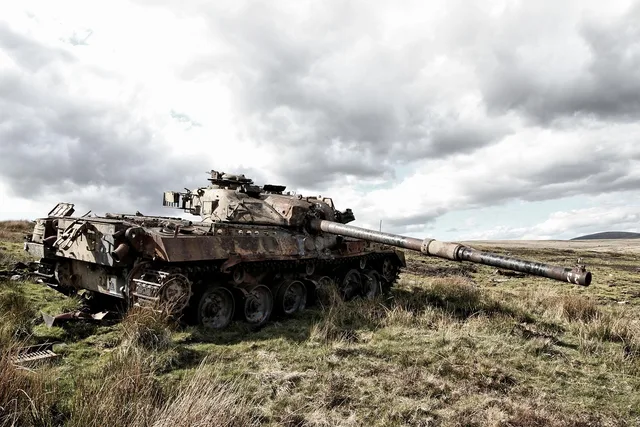
A surveyor measures the height of a steel hull in a bright manufacturing facility. Implementing national defense tech solutions often requires changing the physical dimensions of the vehicle to accommodate new equipment or crew needs.
Even small changes in height can significantly impact the interior layout.
One significant difference between the two variants was hull size: the Swiss variant is 100 mm higher over the front, with an additional 70 mm over the combat compartment at the rear. These modifications provide the necessary volume for specialized systems.
I observed how these extra millimeters change the entire silhouette of the vehicle.
Manufacturer design improvements must also account for the structural integrity of the chassis under heavy turret stress. As turrets grow in caliber, the hull must be reinforced to prevent cracks. This structural evolution is a constant necessity in heavy vehicle production.
How can future tank system needs be met through modularity?
A logistics officer checks a list of modular components ready for installation on a transport truck. Meeting future tank system needs relies heavily on the ability to swap parts and upgrade subsystems without rebuilding the entire vehicle.
Modularity is the cornerstone of long-term fleet sustainability.
To implement a modular upgrade, follow these steps:
- Identify the specific threat profile, such as 30 mm APFSDS or IEDs, to select the correct armor kit. 2. Install the required turret, such as a Hägglunds E-series or a Bofors system, based on the mission requirement. 3. Integrate specialized ammunition programmers into the existing cannon system to enable varied firing scenarios.

Perform a final check to ensure that the added weight of the new armor or turret does not exceed the suspension's limits. This ensures the vehicle remains mobile and stable.
| Component Type | Specific Model/Feature |
|---|---|
| Turret Type | Hägglunds E-series |
| Cannon Type | 35 mm Bushmaster |
The limitation of these upgrades is that armor protection over the frontal arc is classified, meaning exact defensive capabilities for all models are not publicly disclosed.
- How do manufacturers approach tank technology challenges?
- What are the solutions for armor system development hurdles?
- How is firepower adapted for different combat vehicle tech problems?
The same subject is also called War machine advancement tasks.
Related
FAQ
Can hybrid drives improve vehicle efficiency?
What kind of protection do ceramic armor kits provide?
Related posts
Missile system reliability plan: Guide to hardware evolution
DPRK submarine tech evolution: How to guide analysis

Russia drone tech needs: How to guide mass production best



Comments 0